Why the coast changes the rules
Secret Harbour, Golden Bay, Singleton and the beachside parts of Port Kennedy and Warnbro sit on young coastal dunes. The ground is pale sand, often calcareous, with limestone underneath in places. It drains almost instantly after rain and holds little nutrient. Further inland, toward Baldivis and Karnup, the sand gets older and greyer, and there are low-lying areas near wetlands where the water table sits closer to the surface.
Above the ground, the dominant force is wind. Through spring and summer, a sea breeze arrives most afternoons from the south-west, often strong and carrying salt spray. In winter, cold fronts bring gusty north-westerlies and heavy showers. Trees on the coast get both: steady salt-laden wind for half the year and storm loads for the other half.
These two conditions, poor sand and constant wind, explain almost every tree problem people call about around Secret Harbour.
How trees adapt to dune sand
Shallow, wide roots
In sand, water drains below the root zone quickly unless the garden is reticulated. Trees respond by spreading roots wide and shallow, chasing moisture from sprinklers, lawns and leaking pipes. On a typical estate block, a tree's roots can run well past its canopy, under paths, beside pool shells and along retaining walls.
That has consequences. Wide shallow roots are good at finding water but less good at anchoring a tall, heavy canopy, especially when the sand is saturated after winter rain. It also means digging near a tree, for a pool, extension or new paving, can cut a large share of its roots and destabilise it.
Drought stress and dieback
Summers are long, hot and dry. Trees that were established with plenty of garden water can suffer if reticulation is reduced or switched off. Signs of stress include thin canopies, leaves dropping early, and dieback at the top of the crown. Stressed trees are also more prone to pests.
How trees respond to salt wind
Salt spray settles on leaves and buds on the windward side and damages them. The result is a classic coastal shape: a thin, browned, sometimes bare side facing the sea, and a full, heavy side facing inland. Over time, the tree effectively grows away from the wind.
For an owner, this has two practical effects:
- Deadwood builds up on the exposed side. Small dead branches and twigs accumulate where salt has killed growth. They are not usually a major hazard individually, but large dead limbs are.
- Weight builds up on the sheltered side. That is often the side over the house, because the house is what provides the shelter. Long, heavy limbs extending over a roof are the most common reason people ask about lopping.
A sensible approach is to remove deadwood from the exposed side and reduce the heavy side by cutting back to strong lateral branches, which brings the canopy back into balance without stubbing it.
The common species
Tuart
Tuart (Eucalyptus gomphocephala) is the big eucalypt of the coastal plain, naturally found on limestone-based sands. Remnant tuarts stand in some parks, reserves and older or larger blocks, particularly toward the rural edges. They grow into very large, spreading trees with heavy limbs and dense timber.
Tuarts are long-lived and valuable for wildlife, so removal should be a considered decision. Common work includes deadwooding, end-weight reduction on long limbs, and clearance from roofs. Like many eucalypts, they can drop limbs without obvious warning, sometimes on hot still days. Where a tuart is on rural or special rural land, check with the City of Rockingham before removing it, because native vegetation on those lots is treated differently from standard residential land.
WA peppermint
WA peppermint (Agonis flexuosa) is probably the most common tree on coastal streets and gardens. It handles salt and sand well, has a graceful weeping habit and smells of peppermint when the leaves are crushed. It also grows larger and wider than many people expect on a small block.
Peppermints respond well to careful pruning and tend to resprout. That makes them good candidates for reduction rather than removal. They can produce suckers from the base, and multi-stemmed specimens sometimes develop weak unions between stems. Have any split or cracked union looked at before winter.
Norfolk Island pine
Norfolk Island pine (Araucaria heterophylla) is the tall, symmetrical conifer often seen near the beach. It was planted widely because it tolerates salt wind. It grows straight and tall, with tiers of horizontal branches.
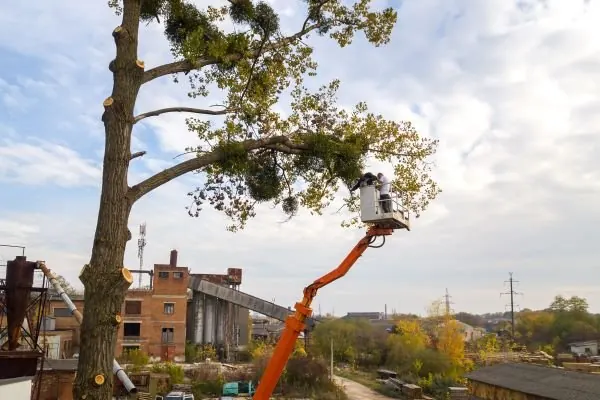
Norfolk pines cannot be lopped in the usual sense. Cutting the top or shortening the branch tiers spoils the form permanently. Work usually involves removing dead lower branches, managing cone drop and, when a pine has become too tall for its location, removing it in sections. Dieback at the top of a Norfolk pine is a sign to get it inspected. On a coastal block, a large pine near a house is one of the trees most often taken down by a climber or platform working from the top downward.
Other common trees
- Rottnest Island pine (Callitris preissii): a native conifer of coastal dunes, tough and salt-tolerant.
- Coastal wattles: fast-growing and short-lived. They often reach the end of their life within a couple of decades and start to collapse, which is a common reason for removal.
- Banksias and paperbarks: more common inland and on larger blocks around Baldivis and Karnup, and near wetlands.
- Palms: Washingtonia, Canary Island date and cocos palms are widespread in gardens. See palm tree removal for how they are cleaned and removed.
- Ornamental exotics: figs, liquidambars, jacarandas and others planted in gardens. Many struggle on the exposed side and do best in sheltered courtyards.
Signs a coastal tree needs attention
- A lean that has changed, especially with cracked or heaved sand on one side of the base
- Large dead limbs, particularly over the house, driveway or play areas
- Splits in the trunk or main forks
- Fungal growths at the base or on the trunk
- Dieback at the top of the crown
- Roots lifting paving or pressing on pool shells and walls
- Small holes with fine sawdust on the trunk, which can indicate borer activity
None of these alone means a tree must come down, but each is a reason to have it inspected.
Pruning versus removal on the coast
Coastal trees can often be kept with sensible work rather than removed. Deadwooding the exposed side, reducing the heavy side and thinning the canopy to let wind through can make a tree safer and more manageable. Our tree lopping page explains how a proper reduction is done.
Removal is the better choice when a tree is dead, structurally failing, or in the way of construction. On tight estate blocks, that usually means a sectional removal. See tree removal for how that works.
Rules worth knowing
- City of Rockingham. The City has said its planning scheme does not require approval to remove trees on standard residential lots, while native trees on rural, special rural and special residential lots need City approval. The City has also been consulting on significant trees on private land. Check its current position before removing large trees.
- Verge trees are managed by the City. Report concerns rather than pruning them yourself.
- Power lines. Trees near the service line to your house need an authorised contractor. Western Power is the network operator for lines on poles.
- Green waste. The Department of Primary Industries and Regional Development has quarantine rules for moving wood in areas affected by the polyphagous shot-hole borer. Check the current map.
- Digging. Before stump removal or replanting near services, use Before You Dig Australia.
Replanting for the coast
If you are replacing a tree, pick a species that suits the sand, the salt and the space. Check the mature height and spread against the distance to the house, pool and power lines. Local coastal natives tend to cope with the conditions better than exotics. Water a new tree deeply while it establishes, then gradually reduce watering so the roots grow deeper rather than staying near the surface.
Need help with a coastal tree?
Call (08) 9515 3848 during phone hours or send the form with photos of the tree and the access. A local contractor will come to look and quote in writing. The cost guide explains how prices are put together.