Grinding is not always enough
Stump grinding takes the stump down below the surface and leaves the deeper roots in the ground to rot slowly. That is fine for turf and garden beds. It is not fine under a concrete slab, a pool shell or a set of footings, because as the old roots decay they leave voids that can make the ground settle. Builders and pool installers often ask for the ground to be cleared of stumps and major roots before they start, and that is what stump removal is for.
How a stump comes out
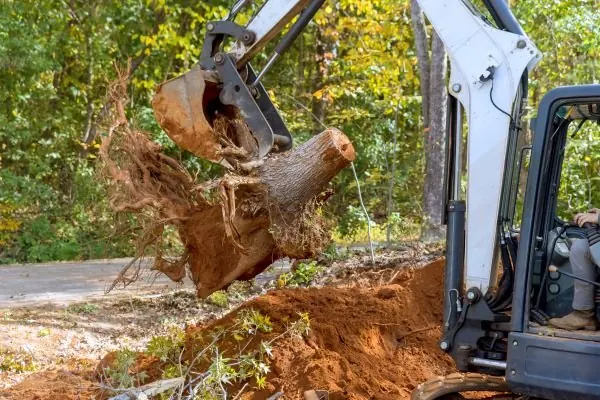
Most stump removals use a small excavator or a bobcat with a digging attachment. The operator digs around the stump to expose the main roots, cuts them where needed, and levers the stump and root plate out. On sand this is usually more straightforward than in clay, because the ground gives way easily. The trade-off is that sandy holes collapse inward, so the excavation ends up wider than the stump.
Where machine access is impossible, a stump can be dug out by hand with saws and bars, but that takes longer and is only practical for smaller stumps.
Roots on coastal blocks
Trees in Secret Harbour, Port Kennedy and Golden Bay have spent their lives sending roots sideways through loose sand, looking for water from the reticulation. It is common to find a main root running under a path or along the back of a retaining wall. Before digging, the contractor should check where the roots go and decide which to pull and which to cut and leave, so nothing is undermined.
Limestone can also complicate things. On some blocks, roots grow into cracks in limestone just below the surface, and the stump comes out with stone attached. Mention any rock you know about when you call.
Underground services
Any digging near the front of a block, a meter box or along a side boundary can find water, power, gas, telecommunications or sewer lines. Before You Dig Australia offers a free service to find out what is mapped on your property. It is worth asking whether the contractor will lodge a request before digging, and marking where your own reticulation and any soak wells run.
Backfilling and settling
Once the stump is out, the hole is filled with clean sand or the material your builder specifies, and compacted if the area is going to carry a structure. Fill does settle, so if paving or turf is going straight over the top, allow for a top-up. If a slab is going in, check what your builder requires before the hole is filled.
Stumps from old removals
Plenty of stump removals are on old stumps left after a tree came down years earlier. Old stumps vary: some have rotted and break apart easily, others are as hard as the day the tree was cut. Some sucker from the base or roots. All of them can be removed, but the condition affects how long it takes.
Combining jobs
If you are having a tree removed and know the stump has to come out too, ask for both on one quote. One visit is usually simpler and avoids the need to bring machinery twice. The same goes for several stumps on one block. See tree removal for the first half of the job.
Prices
Stump removal is priced on the size of the stump and root plate, the machine needed, access, how much backfill is required and disposal. Our cost guide explains what moves the price. For a written quote, call (08) 9515 3848 or send the form.